

Posted: by The Alt Editing Staff
The Alternative is 100% supported by our readers. If you’d like to help us write about more great music and keep our site going, you can become a Patron on Patreon, which also allows you to receive extra content, sweet perks, and The Alternative merch, with levels starting at only $2 per month. Everything helps, and if you can’t afford to donate, consider sharing this article and spreading the word about our site! And if you want The Alternative delivered straight to your inbox every month, sign up for our free newsletter. Either way, thanks for reading!
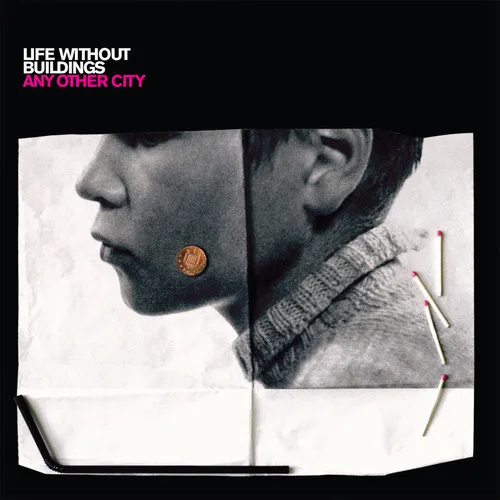
The Scottish indie band Life Without Buildings was together for less than three years, but on the 25th anniversary of their lone album Any Other City, the legacy of their work remains vibrant. Despite writing just over a dozen songs and playing no more than 40 shows in their original time together, the band announced a few reunion dates in Glasgow and London at the start of this year, all of which sold out.
Like much great art, Life Without Buildings’ sound exudes a child-like freedom amplified by the heft of taste and talent. It is an amused angst—when I listen to Any Other City it feels like I’m laying on my back on a playground roundabout, mouthing off to the sky. The band was made up of ex-students at the Glasgow School of Art, originally consisting of Robert Johnson (guitar), Will Bradley (drums), and Chris Evans (bass), before fellow visual artist Sue Tompkins stepped in as vocalist and solidified the sound. Following in the footsteps of Glasgow pop-forward indie acts like Strawberry Switchblade and The Vaselines, Life Without Buildings married a playful irreverence with a dexterous intentionality, allowing for an album that sounds ageless while continuing to attract new audiences against initial odds.
The album’s fourth track “The Leanover” underwent a cultural revival in December 2020 after English musician Beabadoobee posted a TikTok video lipsyncing to the song’s intro, and then thousands of girls started to do the same. The snippet is an example of Tompkins’ onomatopoeic, stuttered wordplay, repeating the phrase “If I lose you” and other monosyllabic words while the band gently builds to form the song. As of this writing, over 111,000 videos have been made using the sound, and while “The Leanover”’s TikTok fame has little engagement with Life Without Buildings and their larger discography, it certainly has contributed to the band’s maintained relevance, reflected in the song’s 18 million Spotify streams.
There is a sense of overdue justice in a new fanbase of young women who have come to adore Tompkins’ vocals, considering her youthful, avant-pop quality was bashed by several male critics upon the album’s initial release. In a 2002 PopMatters review, critic Jon Garrett writes, “Unfortunately, their lead singer, Sue Tompkins, has thrown a wrench in many of these otherwise impeccable compositions by obfuscating their charms with her girlish squeal,” and in a 2005 NME review by John Mulvey, “only mad people and immediate family could warm to Tompkins. Hers is the sound of a performance artist having a self-conscious breakdown.” It is easy to compare Tompkins voice to a child because it’s brazen in expression and often nonsensical in meaning, but to be so shortsighted is a disservice to her skill.
According to her bandmate Johnson, Tompkins had never heard Patti Smith or The Slits before playing in Life Without Buildings, and like those women, it is easier to chock up the pungency of their style to something closer to brattiness than prowess. In a recent interview with The Line of Best Fit, Tompkins talks about how, at the time of Life Without Buildings, she was mostly listening to music on the pop charts like Prince, Missy Elliot, and Kylie Minogue, unlike the boys of the band who had the understandably predictable post-punk influences of Joy Division, The Raincoats, and the Pittsburgh math-rock band Don Caballero.
While the band is often associated with punk, the melody and rhythm of pop and R&B is unmistakable in Tompkin’s vocals, which are more similar to early punk vocalists like Poly Styrene or even Lizzy Mercier Descloux than a contemporary like Kathleen Hanna. Her tone is elastic, pronouncing the same word innumerable ways until its meaning has been pummeled, prioritizing the pleasure of sound over literalism. Some phrases, however, are congealed by a lyrical poeticism that has value beyond enunciation. “Holding you is like the new past,” she sings on “Sorrow,” and on “Let’s Get Out,” “I still believe in getting low, I still believe / The history of half past ten,” her voice coy and earnest in the same measure.
On the first day of recording, Andy Miller, the engineer and producer for Any Other City, said he almost went home because the band was so late to the studio. But once they started playing, he was instantly a fan, especially of Tompkin’s lyrics and vocals, though he was aware the sound went over a lot of people’s heads at the time. “I know the band was a wee bit concerned, I think they had maybe done a couple of recordings elsewhere and a couple of engineers found Sue’s voice tricky to record,” Miller told The Alternative from his home in Glasgow. “I never had a problem whatsoever; I think we just felt really comfortable with each other and that really helped the process. That seemed to be thing; it was like marmite, people either loved it or absolutely hated it.”
While Tompkin’s singing is the fun and flair of the record, the compositions by the rest of the band are the beating heart, from the propulsive Tom Verlaine-esque guitar playing, to the thick, rambling basslines. “The Leanover” exemplifies the cyclical grooves present across the album, which are both exuberant and reliable, until the album’s closer, “Sorrow.” The last song is a departure in both tone and length, a seven-minute “Pale Blue Eyes”-indebted ache that gently pushes the listener out of the album and back into the world. On “New Town,” Tompkins sings the phrase, “Rhythm and knowledge regenerate,” a pretty apt description of the band’s meaty role in creating the Life Without Buildings’ sound. The propulsive hiccup of odd-time signatures and the commitment to intricate, viscous melodies allow Tompkins’ vocal brilliance to glisten.
The band’s story is simple yet unpredictable—they get asked to play a show, and despite having only a couple of rehearsals and three songs under their belt, they do. At this first show they received a recording contract, and after putting out two singles that played on BBC Radio 1, they made an album that charted on the Radio 200. A year later they broke up. Until the shows that were recently announced, they haven’t reunited. The only sign of the band has been in the posthumous 2007 live album Live at the Annandale Hotel, which seemed to come out of nowhere.
The immediacy of Life Without Buildings’ recognition and subsequent resources sounds nearly impossible today. Miller says the band’s rise to cult prominence was surprising for the time. “Even then, for them to be on Tugboat [Records, a now-defunct Rough Trade imprint], the situation was slightly unusual,” he said. “I suppose everything about the band was against the grain and unusual.” Life Without Buildings didn’t begin with aspirations to be millionaires or to even have careers in music. They broke up because what had been “for a laugh” had become too serious. Reflecting on the band decades later is an idyllic notion of how music can be: dedicated fun with one’s friends without the pressures of self-promoting on TikTok or getting placed on prominent playlists, and to take risks without having to consider how those risks will be interpreted by a streaming algorithm. On the seven-minute album closer, “Sorrow,” Tompkins simply sings, “Take the time / Make our own rules.” And that’s exactly what they did.
––
Johanna Sommer | @jojosommer