

Posted: by The Alt Editing Staff
The Alternative is ad-free and 100% supported by our readers. If you’d like to help us produce more content and promote more great new music, please consider donating to our Patreon page, which also allows you to receive sweet perks like free albums and The Alternative merch. And if you want The Alternative delivered straight to your inbox every month, sign up for our free newsletter. Either way, thanks for reading!
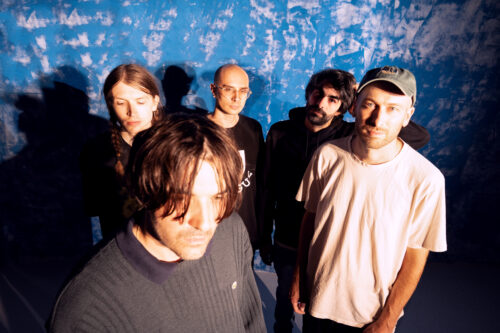
Photo by Anya Broido
Ulrika Spacek is returning to tour North America next month, stopping in a dozen U.S. cities along with Montreal and Toronto.
The English quintet just released their fourth album EXPO, a smattering of analog sounds, abstract lyrics, and luscious instruments in constant conversation with one another. It’s a modern album that reflects the discordant nature of the current rock and, frankly, global culture of 2026.
Frontman Rhys Edwards took time to speak with The Alternative about the latest album, Ulrika Spacek’s creative process, and the band’s upcoming tour. Get tickets to their upcoming tour here.
First thing I wanted to ask was about the recording space, Total Refreshment Centre is what I read—what was that like and how did that compare to past recording sessions?
Basically, we’ve been moving studios for many years. The first two albums [The Album Paranoia and Modern English Decoration] we recorded at home, and that was very much our studio, but then we lost that house. And then as is often with London with the threat of luxury apartments and stuff. We’ve been in studios that have closed and this one now where Syd [Kemp, bass] has kind of taken it over.
Total Refreshment Centre has been there for over 20 years and there’s always threats but it’s just an amazing space that is almost like run like a cooperative, so it’s Syd [who] kind of manages it if you like, but there’s many people working from there contributing to the space and it’s just very inspiring because many artists have little studios there and there’s always people coming in and out. It’s one of the great things of the East London music scene and we’re very happy to be part of it.
It’s quite important to say on this record that it’s very much a group production, five brains. But that said, we’ve all gotten better at producing so it’s been a nice process to be able to get better and to basically achieve the sound that you have in your head and use stuff we’ve never done before, like samplers.
What jump started the record and what kind of prompted you guys to say, ‘okay we should start recording’?
Well, two, two reasons really. I think we had a great tour of the US [in 2023 and 2024]. We’re very lucky we have a big enough audience to tour America, and such is the way, you get a visa and it lasts for us, like one year. We had a great tour and after the last album, which took so long to finish for many reasons, we kind of set ourselves a task to work fast and try to basically get back to America on the same visa. Now, that didn’t work out in the end because once you get into it, we always end up spending two years working on it—but it started with good momentum.
The second reason I would say was Callum [Brown], the drummer in the band, he was very much one that was forcing us to to start, and he did that by making lots of like drum loops to work from. We’ve often written to drum loops, and in the past, that’s been like sometimes just a boring four-on-the-floor [rhythm] because we didn’t know how to program drum machines. But this time, it was very percussive and very swingy, and it was just quite inspiring. That then led us to, because we don’t all live in London—I live in Sweden, for instance—make a sample bank where basically everyone just made little snippets of little ideas.
We were trying to capture this sort of childlike naivety which there is magic in that because, I think, especially after multiple albums, if you sit down and say, ‘I’m going to write a song today,’ I mean that can be quite a daunting thing. And that was like a challenge and that was fun, you know, because it’s like when you’re trying to put two things together that don’t work, but like then and then you have to change the key, you change the pitch, and and it just basically we think makes more exciting music than all sitting down and having a jam.
I think it’s quite interesting when you have ideas that are pulling away from each other, there’s a bit more tension to that than if you jam in a room, I think by the very notion of that you’re actually trying to bring everything together all the time. Everyone’s trying to think as one, it’s quite cool to have like five brains in different worlds.
I think what you’re speaking to is something I hear in the band. It feels like, a lot of times, the instruments are speaking to the lyricist and the lyricist is kind of communicating back almost like they’re in conversation. Is that kind of like what you’re kind of achieving with what you’re what you just described?
And on a lyrical level, especially on this record, it was quite meta in that a lot of the lyrics are actually talking about the artistic process as well and sometimes talking about the band as a collective and as artists working as a collective. That felt pretty fresh because there has been a tendency in former albums to write in a very individualistic way, which is almost ‘Woe is me,’ and the lyrics [on EXPO] are a little bit more abstract. But yeah, I mean this notion of all of us kind of like talking to each other via the parts that we make. There’s definitely a conversation going on and that’s essentially what makes it very collective.
It feels like there’s a culmination of all the sounds you guys have been working on.
On former albums, there was that talking, but it was mainly guitar parts talking to each other—there were a lot of three guitar parts that would interweave. I think the interweaving thing is kind of part of our sound, but this time it was more the instrumentation was a lot different, so the interweaving could be in not just synth, but like cut up samples of, testing a piano.
I don’t know if this was maybe you’re cutting from or sampling from one of these, but “Weights & Measures,” when the strings come in, it feels almost like a Bond song or something. It’s very majestic.
Part of what we like about that idea is that it’s something that just comes in for 30 seconds and then disappears. Originally that song was very hard to put together actually, that took a lot of maths and brain—but that [sample] originally started the song actually, so it was almost like the song started with this sort of James Bond statement. We joked there was James Bond, but it does sound a bit like that, very grand and yeah, we like that bit.
One thing I was wondering about, and maybe you don’t even have an answer for this, but I did notice that this was the first Ulrika Spacek album that had more than ten songs—was there a decision behind that or did it just kind of come to be?
Well, actually, it was ten songs originally because the intro was actually connected to “Picto,” which is the second song. It’s funny, we don’t set ourselves a rule to make ten songs on an album, but it’s very weird that all of our albums seem to come in at ten songs and around 45 minutes, because in the writing process nothing is off of the table, so it’s strange. In the end we did separate that intro because there was something about putting it on its own that meant that it still went into the song that it’s supposed to go into but it’s somehow sort of linked to the rest of the tracks as well. It almost sets the time and place.
One of the annoying things about making records actually is—we love the notion of vinyl and we like when you listen to albums, we love the process of turning the side and whatnot—but it can be quite annoying sometimes when you when you set in your mind mind what is side A, what’s side B. Then one side is longer than the other to a point where the vinyl plant is saying that this song needs to be there, that can be very annoying. So there’s always a little tiny bit of tweaks at the end. So for instance, that intro was maybe three times as long.
So is that something fans can expect to hear longer versions of live?
Yeah, we’re working on the songs live now and it’s nice to kind of do elongated versions of things.
Do your day jobs ever influence the music that you guys are working on?
We don’t make enough money to just do music, but we still get rewarded for touring in terms of it’s not as if we don’t get paid anything but we have it we always have to balance things. I’m freelance and I’m an audio editor, which means I either mix bands albums or I edit podcasts. Joe’s [Stone, multi-instrumentalist] a freelance graphic designer, Callum DJs, Syd produces bands. It’s a bit easier for me in that with the podcast work I can actually edit whilst I’m in the van on tour—which I’d recommend to anyone who’s on tour/in a band trying to hold down a job as well.
Then we’ve also got the other Rhys [Jenkins, guitar] in the band who’s a professor, but I don’t think he teaches. It’s more that he works for a university in physics, he’s a PhD guy, so he finds it a little bit harder but over time you just get a bit clever sometimes. The timing of the US tour was partly entwined with the Easter period because it meant that, for him at least, there would be days off that he would have got off anyway.
I think generally working in more creative fields means that you’re kind of accessing that part of your brain. When it comes to computer software, it means that our proficiency at using Logic and Photoshop and all these things are better. I mean what I really like about using Logic for my job and using Logic for music is that—often if I’m working—I’m only two clicks away from just opening up Ulrika. So if I’m doing my day job and I suddenly feel like having an idea, within two clicks I’m doing music and that might just be for 10 minutes, but I can get down or do what I need to do and then I go back to my job. I think that’s inspiring, that essentially you can work fast.
When I’ve had times in my life for instance where music has been more full time and I’ve gone to the studio 9 to 5 to do the Geoff Barrow-Damon Albarn technique, which is like if you if you’re there long enough good stuff happens. But that can be real draining of your soul because when you’re there and nothing’s really coming creatively you can really feel like a fraud, you really feel like a bad artist. We tend to think that often we feel most inspired when to do something, but you can’t quite do it just then.
I’m really excited to hear this album live and I’m wondering what are you excited to see in the US this time around, if anything?
Well, not to make a joke, but we actually haven’t been to Montreal and Toronto before. We’re looking forward to that leg the most just because we’ve never been. I mean we love to own America and one of the reasons is that the audiences are great and they really know that we’ve come a long way. So, if you play one gig in each state, I mean it blows our minds, when people drive for 5-6 hours because you’re playing their state. Of course, there’s a lot of bad press about America, there’s a lot of things that are wrong with America; we all know that, but one thing that cannot be dismissed is the subculture.
There are so many amazing people there and some of the kindest people we’ve ever met have been in America when it comes to helping us out with equipment and stuff. We’re looking forward to being with our people in that sense because we also like to think we live a subcultural life.
––
Dilpreet Raju | @dilpreetraju