

Posted: by The Alt Editing Staff
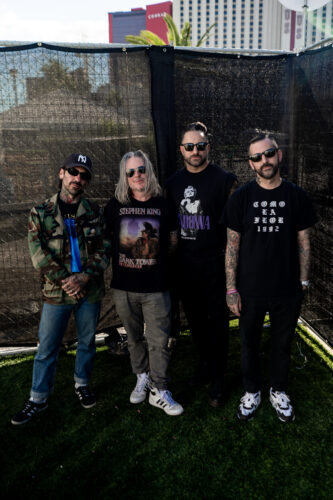
The traditional gift for a 25th anniversary is silver. And for their Silver Jubilee, Bayside, who formed in Queens in 2000, decided to gift their fans a tour unlike any in recent memory. The Errors Tour, which is wrapping up its third leg, sees the band perform songs from their first four albums on Night 1 in a given city and songs from their last five on Night 2.
That’s an ambitious concept, and one that didn’t quite sink in until the band—lead vocalist and rhythm guitarist Anthony Raneri, lead guitarist Jack O’Shea, bassist Nick Ghanbarian, and drummer Chris Guglielmo—sat down to finalize the setlist.
“We pride ourselves on being a good live band, so anything we play, we want to be playing lights out,” Raneri tells me. We’re on the phone to discuss not only the Errors Tour but also Bayside’s debut studio album, Sirens and Condolences, which just recently turned 20.
“Having 50 songs prepared that we can play with our eyes closed, for some reason we did not think about how difficult that was gonna be,” Raneri adds with a chuckle. “When we first conceptualized this, it wasn’t really until we started getting into rehearsals that we were like, ‘Whoa, how did we not consider this, how hard it’s gonna be?’”
Of course, being consummate professionals, in the end Bayside dialed the setlists. The result has been an injection of energy that has galvanized fans and the band alike for the novelty of it all.
“It’s so fun when you’re doing something different,” Raneri says. “I always use this analogy of venues, where every once in a while you play something that’s so different, it makes you feel more present. You have to turn off autopilot because you’re now present in this new situation, and that’s what breaking out all these songs that we don’t normally play is like. A lot of these are not songs we’ve played thousands of times, like ‘Devotion,’ ‘Sick Sick Sick,’ ‘Blame It on Bad Luck.’ You play ‘Guardrail,’ and you have to turn autopilot off.”
“Guardrail,” the closer on Sirens and Condolences, has been, throughout their career, easily the most frequently requested Bayside song. But it hasn’t made many live appearances—setlist.org (not an exhaustive resource, to be sure) only lists 13 plays between 2004 and the start of the Errors Tour. There’s a reason why some of these fan-favorite deep cuts rarely make it to the stage.
“People would ask for it, and we played it and nobody would know it; everybody would stand there,” Raneri says. “It was a complete dead spot in the set. It was always the most requested song that nobody ever actually wanted to hear. We’re doing it every night on this tour, it was the most requested song for this tour by a lot, and it still doesn’t get the reaction you would think the most requested song would get,” he adds with a chuckle.
“If we did an underplayed songs tour, smaller venues sell out immediately. People who are gonna get the tickets are gonna be those diehard fans hanging on every announcement. That’s where ‘Guardrail’ is gonna crush.” It’s something the band has to be conscious of when they’re playing bigger venues on tour. “We have decades of evidence of that, but it doesn’t change the fact that we do those bigger shows, and people are like, ‘You didn’t play “Guardrail,”’ and we’re like, trust me.”
That’s a little bit of inside baseball for you, but Raneri prefers not to share too much about what happens behind the scenes. He’s a born showman, understanding that his job is to create a consistent, first-class experience at every show. It involves a lot of professionalism and dedication, but also a little magic, and Raneri prefers that some parts of the creative process retain their mystery.
Another rare live song from Sirens that’s been a mainstay of the Errors Tour is “Just Enough to Love You,” which had initially appeared on the Bayside/Name Taken split in March 2003. Every other song on Sirens was written after the band signed with Victory Records later that year. They had burned through their early songs on demos and EPs, and the months between signing with Victory in 2003 and the release of Sirens in January 2004 were a flurry of writing and recording.
“Masterpiece,” the one song from Sirens that has consistently appeared in the band’s setlists over the years, was the last song written for the record. “I remember writing it sitting on the floor of the recording studio,” Raneri said. “I certainly did not realize that ‘Masterpiece’ was gonna be the most popular song on that album.” Indeed, “Poison in My Veins” had been demoed and well-received; that the band thought it would be the breakout hit is evidenced by its position in the sequencing, the No. 2 “banger” slot.
Bayside was dead set on having producer Sean O’Keefe make Sirens. He had produced, mixed, and engineered 2003 releases from Spitalfield, Motion City Soundtrack, and Fall Out Boy, whose Take This to Your Grave went on to be certified gold. But O’Keefe wasn’t interested, and Sirens was ultimately produced by J. Robbins of Jawbox.
“To this day I’m not sure J. liked the band or the record,” Raneri says, laughing.
“That might have been an internalized sort of thing,” he admits. “He was this cool indie rock emo pioneer who was in this cool band from the D.C. scene and he came up with Ian MacKaye, and we’re this fucking pop punk band who’s making this pop punk record. This was me entering my ‘nothing I ever do is good enough’ era, so we have this super cool emo pioneer producing the record, and we’re on Victory, and Thursday kind of just changed the world with this sound and now everybody’s emulating Thursday and everybody’s screaming and we don’t scream. We’re also not New Found Glory or Good Charlotte or Simple Plan; we’re not as poppy and good-looking and catchy as they are, we’re not as heavy as Thursday and all that.”
“There was this total self-doubt. Who are our people? Because I want to be Frank Sinatra and Jack wants to be Frank Zappa, and we look around at our peers and we’re like, ‘Shit, I think we’re the only people who think Frank Sinatra and Frank Zappa are cool.’”
Why are the Killers the Killers and the Strokes the Strokes? “They were so of the moment it was immediately nostalgia; it became a callback to that time and place,” Raneri posits. “That’s how we avoided it. That’s what kept us smaller than all those other bands; we didn’t fit what was happening at the time. We certainly paid the price for it then, but it’s paying dividends now. Since then, we’ve talked about how we want to be the Cure, we want to be Metallica. We don’t want to be so quintessentially right now that it doesn’t age well.”
There’s no question that, 25 years in, Bayside have found their people. The Errors Tour appealed to those diehard fans who clamor to hear “Guardrail” show after show as well as the fans in the large venues who just want to hear the hits.
And if you didn’t see Bayside on this tour, don’t fret. Even if you did, they’re back to the drawing board to ensure they deliver a fresh experience next time they’re in your town.
“We’re already talking about next fall and what kind of tour we’re gonna do,” Raneri says. “It’s important for us to change the sightlines; we don’t want to play the same venues, same setlists, with similar style bands.”
On the 2024 Worse Things Than Being Alive Tour, Bayside played alongside Finch and Armor for Sleep, a hard-hitting trifecta of early aughts post-hardcore. That meant big venues, big production value, and hits-filled setlists.
On the Errors Tour, having two nights in each city allowed Bayside to work in more deep cuts spanning their discography.
“We can’t play the deep cuts show at the big venue, and if we play the small venue, we can’t afford to have Finch and Armor. There are multiple factors we have to be conscious of,” Raneri said. “Everything we do is calculated with all that stuff in mind, but at the same time we attribute a lot of our longevity to never doing anything that is gonna suck for us to do, and that’s really important. When we were starting out we had to do tons of stuff that sucked that we hated. Once we reached viability and were making a living doing this, our job now is to make sure we never hate doing this.”
So when it comes to the secret of longevity, it just may be this, the Bayside ethos: “What do the fans want, how do we make that work on a business level, and will it be fun for us?”
––
Michelle Bruton | @MichelleBruton
The Alternative is 100% supported by our readers. If you’d like to help us write about more great music and keep our site going, you can become a Patron on Patreon, which also allows you to receive extra content, sweet perks, and The Alternative merch, with levels starting at only $2 per month. Everything helps, and if you can’t afford to donate, consider sharing this article and spreading the word about our site! And if you want The Alternative delivered straight to your inbox every month, sign up for our free newsletter. Either way, thanks for reading!